The crowd effect and home advantage in tennis – how significant is the impact really?

The crowd effect and home advantage in tennis – how significant is the impact really?
When we talk about sport, terms like home advantage and crowd effect are almost unavoidable. In team sports such as football or rugby, it’s well documented that the home side tends to perform better in front of their own supporters. But what about tennis – a sport where players compete alone, often in neutral venues, and where the playing surface and conditions vary widely? Does the crowd truly make a difference, or is the idea of a “home boost” more myth than measurable fact?
What does the research say?
Several studies have explored the concept of home advantage in tennis, and the findings suggest that while the effect exists, it’s less pronounced than in team sports. Data from the ATP and WTA tours show that players tend to win a slightly higher percentage of matches when competing in their home country. For instance, British players have historically performed well at Wimbledon, while Australian players often shine at the Australian Open.
However, the advantage rarely comes from the court itself. In tennis, factors such as surface type, ball speed, and climate often play a bigger role than geography. The real difference tends to come from psychological and social factors: crowd support, familiarity with surroundings, and reduced travel fatigue.
The crowd as an invisible teammate
A supportive crowd can act as a kind of “third player” on the court. The roar of approval after a winning shot can lift a player’s confidence, while jeers or distractions aimed at the opponent can subtly shift momentum. In tight matches, that emotional energy can be decisive.
But not all players respond the same way. Some thrive under pressure, feeding off the crowd’s energy to raise their level. Others feel the weight of expectation, especially when playing in front of family, friends, and national fans. This means that home advantage in tennis is highly individual – it depends as much on personality and mental resilience as on location.
The umpire factor – an overlooked influence
An interesting dimension of the crowd effect is how it can influence officials. In sports where subjective decisions matter, research has shown that referees can subconsciously favour the home side when the crowd reacts strongly. In tennis, this used to be more relevant when line calls were made manually. With the introduction of electronic systems like Hawk-Eye, that bias has largely diminished.
Still, the crowd can affect the rhythm of play. Noise between serves, cheers at awkward moments, or even strategic encouragement can disrupt an opponent’s focus. These subtle psychological battles are part of what makes tennis such a mentally demanding sport.
Læs også:



Home advantage in the Davis Cup and Billie Jean King Cup
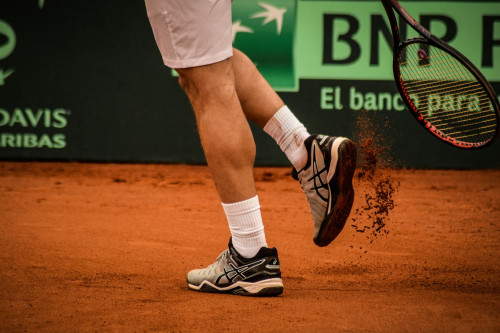
The clearest examples of home advantage in tennis appear in team competitions like the Davis Cup and the Billie Jean King Cup. Here, the host nation chooses the surface and ball type, and the crowd’s involvement is far more intense than at regular tour events.
Historically, home teams have won around 60–70% of ties in these competitions. That’s not just because of the crowd, but also due to tactical choices – for example, selecting a slow clay court if the visiting team prefers faster surfaces. The combination of familiar conditions, supportive fans, and strategic planning creates a tangible edge.
When home becomes a burden
While home advantage is often seen as a benefit, it can also bring extra pressure. Expectations from fans and media can weigh heavily, particularly on younger players or those struggling with confidence. Even at Wimbledon, British players have sometimes spoken about the challenge of managing the crowd’s hopes for a home champion.
Some players actually prefer competing abroad, where they can focus purely on their game without the emotional noise of home expectations. This shows that home advantage is not a guarantee of success – it can just as easily turn into a source of stress.
Conclusion: A small but real difference
The crowd effect and home advantage in tennis are real, but their impact is subtle and complex. For some players, the energy of a supportive crowd can be the spark that turns a close match in their favour. For others, it can be a distraction that tightens the nerves.
Ultimately, it comes down to mental strength and the ability to channel the atmosphere constructively. Home advantage in tennis may be modest compared to team sports – but in a game where margins are razor-thin, even a small edge can be enough to decide victory or defeat.
Læs også: